Showing posts with label animation. Show all posts

17 September 2007

Interview: SARA POCOCK

Sara Pocock is a young animator who received considerable attention for her animated film Ballvaughan Story(see below). With the amount of Flash-based vector animation around, her hand crafted work is refreshing and reminiscent of Yuri Norstein's work. I hope to see the spark of her talent fully take flame in future.

How did Ballyvaughan Story come about? What was your interest in this period of history and how did you settle on using charcoal for its creation?
Well, the film came about as a result of direct contact with the real village of Ballyvaughan, Ireland. While I was studying animation as an undergraduate, I decided to take a semester off to study abroad and work on my own film. I don’t know what drew me to Ireland, but it seemed like the best possible place to go for inspiration. Ballyvaughan is located in a part of Western Ireland that’s dubbed “The Burren.” The landscape is incredible and almost otherworldly in nature.


I began studying at the Burren College of Art and met a local man named Jim Hyland, who was a bit like the town historian. He had this deep and vast pool of knowledge about the history of the village and I became interested in his stories immediately. I asked him if he wouldn’t mind sitting down for an interview and he agreed. He spoke for almost two hours, but one of the tales that really jumped out at me was a story about his mother and her involvement in the Troubles in 1921. It was then I knew I had my story for the animation. The original recording of Jim’s voice was used as narration for the piece to preserve the feeling of traditional oral storytelling.

Around the time I began work on the animation, I was spending a lot of time outside, taking advantage of the Burren’s unique and beautiful rocky scenery to create large charcoal landscape drawings. I liked the imagery from these drawings and thought it might be interesting to create the animation backgrounds in a similar style. I drew some smaller images as a test and was pleased with the result, and the style of the animation just snowballed from there.

Would you tell us about the practicalities of using charcoal for Ballyvaughan Story? What were the advantages and/or disadvantages of this medium?
Charcoal is great because it’s a flexible and versatile tool that’s relatively easy to control. The biggest challenge was maintaining consistency in the character animation. It would be distracting if the light and shadow areas shifted too drastically from one frame to the next. Charcoal can also be very messy and is easy to smudge. I would generally add charcoal to one shot at a time (I drew all the animation in pencil first and added the charcoal later) and scan it right away, or else it would smudge. I went through a lot of trail and error to finally nail down an efficient method.

And would you tell us about your integrations of 3D elements? How did you achieve this and what were the difficulties in the process?
I got Ke Jiang, an amazing 3D animator, to help me out with the 3D elements. Originally the film opened with still drawings of the charcoal landscapes, which felt was a bit too static. I still wanted to use the landscape as an establishing shot, so I asked Ke if he could help make it look more interesting. He basically took my original charcoal drawings and built a topographic map of sorts in Maya, a process called 3D mapping. He then built a camera in Maya and used subtle pans and zooms to create depth. I was quite pleased with the result.


There’s a wide variation in your work and you’ve used a variety of techniques from stop motion and CGI to the freeflowing forms of your latest works. Would you say you’re still experimenting with your styles? And what advantages do you see in the different methods you’ve used?
I’m definitely still experimenting. As I’ve only taken baby steps into the independent animation world there are obviously many techniques I haven’t had the chance to try yet. And because of my relatively young age and inexperience, my own technical skills aren’t developed yet.

I hope to work in as many animation mediums as possible. Each type of animation has its own charms and drawbacks. I’m most drawn to classical 2D animation because of my love for drawing and interacting with a pencil and paper. But I love what artists are doing with 3D animation and especially mixed mediums. My next piece, in fact, is a 2D/3D hybrid that combines traditional ink drawing with cut-out character animation and 3D environments.


How did the collaboration with Ke Jiang develop? How do the two of you approach collaborative work and have you learned anything while working with Ke Jiang?
Ke and I attended the same undergrad college, where we both majored in animation. We’ve been working together and helping each other out with our respective films for a while now, but the new project marks our first directorial collaboration. I think we’re both very detail-oriented people who know how to use our personal strengths to balance the other’s weaknesses. Ke is very good on the technical/computer/troubleshooting side of things, and also has an incredible flair for strange and unique stories and characters.

I tend to be a little softer in my approach to animation, with roots in more traditional storytelling and emphasis on character movement. For the new project, I storyboarded the animation and designed the characters, while Ke handled art direction and experimented with ways to animate the characters in a 2D/3D hybrid environment. We’re in the process of animating the film now, and I’m very happy with the initial tests.

Would you tell us about your upcoming animation? Are you experimenting with anything in this film in terms of story or design?
It’s loosely titled Monkey and Bear, and Ke Jiang and I are co-directing. The story itself is rather folklore-ish, and won’t rely on dialog to tell the story, but rather the characters’ interactions with each other and their environment. The design is all over the place—we’ll have sequences entirely in 2D animation, and some sequences that are entirely 3D animation—but the overall art direction is heavily inspired by 1970s Russian animation. Ke and I both admire the work of a famous Russian animator named Yuri Norstein. His films, specifically Hedgehog in the Fog and Tale of Tales, were a huge influence for the look and feel of this piece.

"I originally planned for Ballyvaughan to be completely black-and-white"


What is your approach to colour? In Ballyvaughan Story and your upcoming collaboration, the colours are almost entirely absent with the exception of the characters giving it a brilliant folksy feel—How did this approach to colour develop?
It just seemed to happen. I originally planned for Ballyvaughan to be completely black-and-white. But somewhere along the way I decided I needed a visible symbol for the protagonist’s development—her growth from a scared little girl into a courageous young woman. And I intuitively decided to gradually turn her from black-and-white to colour throughout the piece.

In the new film, again, I’m borrowing a Russian colour theme, with slightly more vibrant colour on the characters to match their complicated personalities.

You’ve sourced elements from your childhood for Memory. How much would you say growing up in Bremerton/Puget Sound area influenced you and your work? And in what way? Likewise for other places you’ved lived/learned like Ballyvaughan?
Well, I moved around a lot as a child. I lived in Bremerton for five years, in a tiny rural town called Macungie in Pennsylvania for six years, and finally in a suburb of Houston, Texas for another six years. I moved to Minnesota after that for college. And I live in Los Angeles now. Because of this, my memories from childhood are divided into very specific sections—I have the Washington era, the Pennsylvania era and the Texas era. Out of those, I think it’s Pennsylvania I feel the most nostalgia for.

Whenever I imagine the “good old days,” it’s always in that small countryside town. I was at a time in my life then (6-12 years old) when my imagination was free to roam unchecked and the country provided more than enough inspiration. Most of the crazy ideas I have stored in the file cabinet in the back of my brain originate in that age, and the themes I’m drawn to—folklore and coming of age tales—are stories I want to tell to that dreamy, fanciful little Pennsylvanian girl.


What animators do you admire and inspire you? And what other artists inspire you and why?
I always get nervous when this question arises because the sheer amount of artists I admire is so large I could talk, literally, for days on end. There are so many talented people in the world using their gifts to inspire, inform and delight—I wish there was a way I could broadcast my appreciation for every single artist whose work I’ve encountered in my life. Just to name a few, though…

Yuri Norstein is my biggest animation inspiration right now. His work is so incredibly delicate, both in its storytelling and its visuals. I admire how he can invoke powerful emotions with relatively simple imagery, without words and traditional story arcs. I hope to someday create a film that can touch someone’s heart the way Tale of Tales affected me.

On the technical skill side of things, there’s a Japanese animator named Shinji Hashimoto I’m currently in awe of. His character animation is stylized and wonderful (and decidedly un-Japanese) and I could watch it for hours. His drawings are very free-form and often break away from the model sheets, and his senses of timing and movement are similarly unique. I hope to one day achieve the same level of expression in my character animation.

I’m also a huge fan of Kurt Vonnegut’s writing. He was a brilliant satirist who encouraged people to think outside the box. I’m in love with his prose. Finally, there’s a harp player named Joanna Newsom whose music I can’t get enough of. Not only is she an amazing songwriter, but she’s a brilliant lyricist as well.

Would you choose a colour (it doesn’t have to be a favourite) and explain the ideas and feelings it generates for you? This doesn’t need to be a straight answer – express yourself in any way you feel is suitable from an explanation to a haiku or image
I love green, especially in a natural, environmental context. It makes me feel relaxed and nostalgic. Green is a colour I wish I saw more of in Los Angeles. The greys and browns of concrete (and polluted air) get depressing after a while.


Also, would you select an image that you feel is powerful (it can be a painting, a photograph—and does not need to be art, it could be a package design or an object) and explain why it has an impact on you?
Wow, that’s a tough one. Hm… it may be a cliché, but I get goosebumps every time I look at Vincent van Gogh’s The Starry Night. Can you imagine what it would be like to look up into the sky and see those brilliant flashes of light and color—stars and galaxies as large and bright as the moon? I enjoy stargazing myself (although I’ve never been an expert on constellations by any means) and love the idea of a vast and infinite universe. It’s perfect for stirring the imagination.

What are you aspirations and where would you like to be in 10 years? And when do you expect your latest animation to be released and are there any other works in development?
I’m crossing my fingers and hope that I’ll still be an animator 10 years from now. I honestly couldn’t see myself doing anything else for a living. There are a lot of things in the animation world I’d like to try. I definitely want to spend more time in the independent scene and attend more festivals. I admire and respect independent filmmakers so much for all the love and determination they pour into their films. As long as I can keep creating art I’ll be happy.

Thank you, Sara.


Links:

Sara Spot
Ke Jiang
Sara Pocock (No fat clips)
Sara Pocock (Animation blog)


22 May 2007

Interview: The Blackheart Gang - MR. JANNES


In the second of the Blackheart Gang interviews, we have Jannes Hendrikz whose responsibility is in essence to make Ree Treweek's drawings dance to Markus Wormstorm's music. He is the compositor, 2d-animator, cinematographer, and creative director of the team. Jannes recently left Blackginger (who created the 3d elements and provided the hardware required for The Tale of How) to freelance.

As well as providing generous answers to my queries, he has also kindly provided some exclusive stills and moving images from early in the production of The Tale of How.

The Tale of How is free to download HERE and more information is available in previous posts HERE, HERE and HERE. See the first installment of the Blackheart Gang interviews with Ree Treweek HERE.

From the perspective of artistic direction, is the look from the Tale of How something you want preserved or do you see the project evolving over time?
I am very much into spontaneous, interactive expression of our art forms. I see The Household project as a growing interactive medium. It goes wherever it needs to go and I follow. It’s about being attentive to its needs and letting it grow.

How important was Ringo as a foundation for the work you did in The Tale of How? What did you learn while working on it? And is Ringo set in The Household?
Yes, Ringo also forms part of The Household. Before we started Ringo none of us knew eachother that well; most of us had just met at the time. We wanted to do something, make something. I don't know. A type of creative chemistry just developed among us. At the time, none of us had any real experience; we just threw ourselves into it. Ringo started as a weekend project but we ended up working on it for another nine months. We didn't plan. Things just developed. I think that this is the basis of our working dynamic--the magic. We learned as we went along with it.
"We did have a few creative hiccups and we had to move on--we had to compromise, we had to collaborate."
Being a labour of love, you kind of need to offer everyone working on the project the freedom to express themselves so it gets really difficult to do what you want without overlapping with someone else's ideas. We did have a few creative hiccups and we had to move on--we had to compromise, we had to collaborate. This was the biggest lesson Ringo taught us and this secret lies at the base of our collective. Learning to collaborate opens up creative doors and solutions, and helps you to develop into a more mature artist. It helps you define yourself and your role. And this was the next lesson.


Ringo(2004)

We knew that if we were to work on the next project we would have to define our roles. So before working on Tale of How we had loads of discussions about who wants to do what and what we'd like to achieve and how we can support each other in doing so. I had to be very sensitive to the needs of the people I asked to join. I really wanted to create an environment for everyone to grow. Ringo was an essential part of my growth.


You said you nearly had a nervous breakdown at the end of the nine month development of the Tale of How; what happened? Was it that bad?
Hmm...well...yes, it was bad. I wasn't exaggerating. It really took me months to recover. I had a full time job at the time at a visual-effects company that always had work for me. The day work was demanding. So I worked from 9 - 6. popped out for an hour dinner break where I would meet up with Ree. This was our time to see friends and loved ones before we return to Blackginger to work till 1 - 3 in the morning. This was the ritual for every other day, except weekends where we would work from 10 in the morning to late at night.

During this time me and my girlfriend bought a flat that we moved into. By the end of it...the last 2 months, my morale was at an all time low. I was tired and worn out. I had to focus myself to finish this thing that took over my life. My boss was complaining that my private life is interfering with my ability at work. My girlfriend at this point completely frustrated with the fact that I'm never at home and emotionally unavailable. The last weeks I kept on falling asleep watching renders, stared into space and when we finally finished both me and Ree didnt know what to think. We didn't know what to feel and then slowly, over the next few months, readjusted to normal life again.

The whole experience was very surreal. I suppose I just have a very intense way of experiencing life around me, I am very passionate. It's the only way I can explain why I push so hard.


Would you give us an idea of your workflow in particular, how you bridge the 2D and 3D in your work? And which software/hardware is/was involved and why? How closely did you work with Justin Baker in the development of the 3D elements and how difficult was it to preserve the look of Ree’s drawings?
I always composite in 3d space; it gives me freedom to play with depth and perspective but then again, I really didn't want it to look like a 3d movie, or like a 2d movie in 3d space. I wanted something authentic so when it came to using actual 3d renders, I decided that they had to look exactly like Ree's linework. Justin modeled and rigged the birds and then started playing around with different shaders. We went backwards and forwards till we found a treatment that worked.

Justin then started animating all the elements on a background plate (2k resolution) I supplied as a placing reference. The 3d renders would then be layered into my comp and the camera moves added. Justin had full freedom to animate the birds using his own interpretation of the story. The only limitations were technicalities or keeping within the story. Me and Justin used to work together at Blackginger, so we were already familiar with our own type of workflow.

We worked on duel 3 gigahertz Dell machines with 3 gigs memory. Justin worked with XSI and I worked with After Effects 6.5. XSI has amazing 2d shader capabilities and rendering in passes also helps. After effects is definitely the only package to use for a project like this. Other compositing packages will not be able to perform in the same way or offer me the same amount of freedom.


Time Lapse Composition

You’ve mentioned that each scene was made up of around 300 layers; what challenges did this present and what did you learn working with such a rich tapestry of elements?
One half of all the elements was Ree's drawings and the other half consisted of atmospherics (mostly video footage) and textures. The first challenge was getting my computer to process all of this. I basically broke each shot into 3 main layers: fore, middle and background. Whenever possible, I rendered out the frames of finished sets, and used them as proxies to be able to render a full shot. I also had to set my views to as low as quarter resolution to be able to preview the shots over the timeline.
"Having so many elements certainly slowed me down, but being able to chop and change and play at any point during the process definitely added to the look of the film."
Most of the time, I just had to render the shots at the end of the night before we left, to be able to check the animation I did during that night. Having so many elements certainly slowed me down, but being able to chop and change and play at any point during the process definitely added to the look of the film. You just need the time to be able to do that. Every shot was crafted and cared for till it felt right, and having all the layers available helped me work like that. In the end, we ran out of time, and some things just had to be left the way they were knowing that we did the best we can.


In creating what we now see as The Tale of How, were there any other versions of the composite before the final? If so, can you describe these?
Well, before we started on the prints, Ree gave me her drawings for page 1 (shot 1). I played around and tested a few ideas. when I finally felt I had something, I really wanted to test it out animated, so I downresed the psd, collected some video elements I had, and put everything together. this was a starting point that I felt happy with and got Ree and Markus to have a look at it. They loved it and thats where it went. In the following days I basically tested cameras and their movement, a few animation teqniques and thought about the workflow and basically made 5 variations of the first test render, and that was that. I knew that I had loads of time to think about the animation while composing the prints and things developed from there.


The first composite test for Tale of How

Are storyboards used at all? Why or why not?
No, we didnt use storyboards for Tale of How. We had 13 verses in Markus's poem and one print for each. The prints took us about 3 months then Ree had to start drawing on all the extra elements we would need for the animation and I started putting things together. We wanted to have more shots and angles but we simply did not have the manpower and time to do so, so we made each shot as beautifull as we could hoping that visually one would have enough to look at and that we could get away with the shots we had.
"I used this part of the animation to add drama and break the pace by using quicker cuts and camera moves unlike anywhere else in the piece."
We just knew that the first part of the story needed to be dark and eerie, and the second half, light and hopeful. We also didn't use the print for shot 8 (the part where the bird gets broken in half) because we needed to build a more dynamic and visually interesting picture than we had. I used this part of the animation to add drama and break the pace by using quicker cuts and camera moves unlike anywhere else in the piece. Our workflow was very much based on the prints. It will be very different for our next projects. We believe in the power of using storyboards.


How far off is The Tale of Then from completion? And what work has been done thus far? Likewise for The Tale of When?
We are planning to start by the end of the year. Now we are just getting our resources together, getting the story fine tuned, then do storyboards, animatics etc etc.--Lots of pre-preparation. We are giving ourselves a year of production time on the next one...all depending on resources. We might even work on the Tale of When at the same time, we don't know, we'll have to see how things develop over time.

What arts do you practice personally outside the Blackheart Gang? And which artists inspire you personally?
Well, the Blackheart Gang's been taking up all my time. If there were a few things I could wish for, it would be for extra arms, the ability to not having to sleep, and longer nights. ah...what I can tell you are my wants. I want to shoot documentries, I want to make puppets, I want to start a theatre production, make music.... sigh!
"Cooking is great because it involves so many of the senses."
As a video & film artist, I am quite removed from the final product. There's a long process to this medium. it rarely ever gives you immediate interaction like playing a musical instrument. Processing just takes too long. The other frustration is that it is a virtual medium. There is no real tangibility so I do long for a more hands-on form of expression. There is something I do regularly, and that is cook. Cooking is great because it involves so many of the senses. It offers so much variety to experiment with, and you can eat what you've made!

I am a lover of listening to sound and music. I can honestly say that I spend 70% of my time on listening. Sound is my deepest source of inspiration. I suppose it’s because it gives me full freedom to interpret it visually. I initially got into video because I visually wanted to create what I saw when listening to music. I like moody, emotional music. Some favourites at the moment include: Svarte Greiner, Dictaphone, Rafael Anton Irisarri, Apparat, Loscil, and the Shins.


I also draw a lot of inspiration from short films at the moment. Its such an amazing medium, such a huge variety of style, technique and experimentation. I am in love with moving picture, it’s enchanting, especially sincere storytelling, mostly without dialogue. Slow visual storytelling oh! I am very much into Russian animation from the 60's and 70's. The beauty, sensitivity and wonder of Miyazaki's films damn! His films always revitalizes me, reminds me of what's really important. Also, my brother gave me a collection of stop-motion by the Quay Brothers and I recently discovered the surreal and bizarre etchings by Max Ernst. Difficult to name specifics... cause I pick up little bits here and there, tiptoeing over what keeps me going.


What have been some of the most important things both personally and professionally that you’ve learned while working on the Blackheart Gang projects?
As an artist, I’ve never learned so much, so fast. Working on these projects and being an artist, I suppose that my personal and professional life goes hand in hand so I've learnt that work is not about the end product; it is about the time you spend around that and how you deal with yourself and others in that time. Enjoying your work and staying true to it is essential. I know now that my self expression is an in-the-moment thing, and it’s at those times when I can truly experience myself and get to know myself and my abilities better... pulling your hair out in despondency, the height of accomplishment, the stress of a deadline or those flowing moments of spontaneity.

Thank you, Jannes. I can't wait to see more of The Household. See you on Otto's hill.

Links:
Ree Treweek Interview
theblackheartgang.com
The Blackheart Gang Myspace
The Concise Overview of The Household
Motionographer Article
The making of The Tale of How(YouTube)
Blackginger


Return to SiouxWIRE

12 May 2007

Interview: SIL VAN DER WOERD


Sil van der Woerd is an independent filmmaker and graduate of the Academy of Arts and Design in Arnhem, Netherlands and attended the Gnomon School of Visual Effects. In 2004, he created Duet and recently released his follow-up Swim. Both works combine live action, effects, and music to carry their narratives and create unique environments.


Swim


Duet


Do you see yourself as an artist, craftsman, or combination of the two? And why?
As an artist. I make films because I want to share a story with an audience, to show them worlds that are inside my head. I don't make films to show that I am able to make them. The precise work of reaching a certain level of detail in the images (to make the imaginative worlds appear convincing) could be called craftsmanship though.

Soundtracks are a dominant feature of your work. Would you explain your choices of music for both Duet and Swim, and how they relate tothe shorts as a whole?
I pick the soundtracks to underline the films atmosphere. For Duet, I wanted a combination of classical and modern music, since that was the theme of the film. I chose heavy beats because I wanted every contradictory and energetic element opposite the sweet girl and dragonfly.

For Swim, I wanted a pulsing soundtrack, subtle in it's changes. Cold, almost like the sound of the ramming of piles underwater.

"Swim was born out of a collection of sketches and a desire to somehow show how insanely magic the power of life really is."
How did the concept for Duet and Swim come about?
The concept for Duet was born while exploring the borders of live action and animation. I was thinking about what animation would need to stand up against live action and visa versa. I started playing with the idea of melted contradictions. Modern and classical dance and music, digital and real images, etc. In Duet, my goal was to bring these elements together and make 1 convincing performance out of it. Swim was born out of a collection of sketches and a desire to somehow show how insanely magic the power of life really is. I wanted to create an almost dead, high tech, by humans controlled space, that would shrink to no importance at the moment new life is born and the forces of nature take over.

When creating your works, what is the most important element and why?
Music is the starting point and biggest inspiration. When I listen to music, visuals automatically start pouring into my head. Music is a great inspiration because music is so widely interpretable.


While working in CG, it's all too easy to fixate on the craft of building as opposed to the overall design; a bit like an architect focusing too much on the building methods as opposed to the end product. Do you recognise this problem and if so, how do you avoid it?
I am familiar with the state of being lost in modeling and aiming for a photo realistic look. CG eats up a lot of time because you yourself decide when your work is finished, and if you're a bit self critic like me, it never really is. So to avoid that, I usually work heavily on a model for a short amount of time. Then I step away from it, and finish it once I am fresh again, or have the courage to throw it away. Deadlines also greatly help to effectively make creative decisions in reasonable amounts of time.
"I learned a lot to literally do every facet of the productions myself."
What would you say are the positives and negatives of CG work?
Positive: no boundaries; all you can imagine is make-able and can appear convincingly real. Negative: no boundaries; because everything is possible, one can easily get lost in the techniques and spend months and months while not being very creative. I feel that certain restrictions are helpful to fully use up the restricted space and find it's boundaries.

Would you tell us about the work flow you employed in your shortsand the software/hardware used? And what were the most importantthings you learned while creating Duet and Swim?
I make the films by myself. This means I am responsible for concept, camera handling, light, producing, editing, animation and visual effects. It may not be the most effective way, but I learned a lot to literally do every facet of the productions myself. The only thing I don't have credit for is the music. I learned the software (Maya, ZBrush, After Effects, Boujou) myself while studying at the Academy in Arnhem and during courses at Gnomon School of Visual Effects in Hollywood. The most important thing I've learned is to make sure that every single function in the pipeline of making a film is of great importance and needs an equal attention. I also learned, that if I want to keep on working on bigger projects without losing my creativity, I need to give certain functions of the process to specialized people, which is what I am doing in my current projects.


How was your time at the Gnomon School? And how does your experiencecompare to your time at the Academy of Arts and Design in Arnhem?
Gnomon was great, I had a wonder full time. Gnomon is all about the technique. They have very experienced teachers. It was the opposite of the Academy in Arnhem where there were no professionals in animation and where it was about the concept mainly. I think these studies were a good combination; at the Academy I discovered my own style and it's importance while at Gnomon I learned to raise the technical side of my work to a more professional level. At Gnomon I also had a great chance to experience some of the film-industry from backstage.

Who are the artists that inspire you and why?
I find inspiration in old Disney movies, Bjork, Chris Cunningham, Arvo Part, Speedy J. To me, these are artists whose work is close to nature or is the exact opposite of it.

What aspirations do you have for the future? And what are youworking on at the moment and when will we see new work from you?
Right now, I am focusing on being a director of music videos. In the future I hope to direct a feature film. At the moment, I am finishing a music video for singer Lolly Jane Blue. The video, called 'Worms' is almost 6 months in production and will be released on Thursday October 4th 2007. Worms will be available on my own website www.microbia.nl and on the singer's website: www.lollyjaneblue.com

Links:
Microbia
Revver

06 May 2007

Interview: YIBI(aka E.B.)

I recently stumbled upon Yibi's work at the CG Society forum where he posted a haunting short called Palingenesia about the cyclical relationship between humanity and technology. Looking into his background, he has an eclectic body of work both personal and professional ranging from the whimsical to the experimental.

Born and educated in Shanghai, Yibi worked for the large broadcasting station Motion Magic Digital Studios from 2000 to 2003. He later went on to gain a Masters degree in Screen Design from Kingston University in the UK creating short films during his study which have played at numerous festivals. Yibi is now working at Red Bee Media in London.


How did you get into graphic arts and what in particular drew you to this field?
I was once into 3D character animation very much but spent too much time on crafting. Motion graphics techniques however provided a reletively quicker way for me to speak in my own language. That is another reason that I started my career as a graphic designer.

What/who are your influences? And how did growing up in Shanghai shape your work(if at all)? Many people are my sources of inspiration… from Saul Bass to Kyle Cooper…But I would say any great work could influence me in one way or another.
Shanghai is a very delicate city. The local culture did help me growing up, giving me a pair of fine eyes.

"...I will do some detailed artwork first to see the potential in stills..."
From idea to finalisation of an animation, what kind of workflow do you employ now and how has your workflow changed/improved over the years?
From the moment I first started doing animation work, I have always been trying to improve my workflow, not only for my own projects but also commercial jobs. I can’t remember how many steps I took to shape my current flow, but it’s certainly been a long way.

Now, if I pick up on an idea, I will do some detailed artwork first to see the potential in stills, then sketch down some fairly complete storyboards. Normally I will start to create things based on all my artworks, or more directly take photos or find the right materials. Once I have most of my elements ready, I will begin to craft my piece.


Would you tell us about the production of your short A Friend I Know?
That was actually my first time directing a live action piece, although I covered the actor’s face with a cgi head. Why live action? …because I never tried it before. Anyway, that’s also an experiment of telling a story in a different way. Live action is certainly much more friendly to the audience. The challenge was… hey… I have to speak to people but not the machine, certainly much more fun.
"...there is always a new way to tell the same story."

What skill would you say is most important to your work and why?
Drawing ability is a great gift and I am quite lucky to have it. As for the reason… well, if I draw everything, the whole world can understand my story. Nonetheless, if I can’t finish my animation, as least I have a comic strip.

There’s a lot of variation in the style of your shorts(and work in general) from the spartan Nothing Personal to the gothic A Friend I Know. What would you say is the common feature or signature of all your work?
I believe there is no “new” story as it is for idea. But there is always a new way to tell the same story. Just like different directors would come up with different films based on a same script. Maybe I haven’t found my “signature” yet…but I am always trying to seek a unique way for my story telling.

In your latest and I believe greatest work yet, Palingenesia, you’ve fused a parable on humanity’s relationship to nature with a free flow of symbols and abstract images that, together with the soundtrack, draws a very clear narrative. Would you tell us about the development of Paligenesia?
I certainly think the short I am working on at the moment will be the best I have ever done. Palingenesia is a quick turn around I did for a small contest. While the topic is technology… the narrative is actually a summary of a topic—earth and humanity— I have been thinking about it for a long time.


Are the dramatic and abstract elements of Palingenesia something that we’ll see more of in your personal work?
Certainly, you don't have too many chances to put the stuff you really like into commercial things

What artists do you admire and/or inspire you?
Too many and there is no dominant one. But certainly stuff from the studios of the Ebeling Group is the most inspiring works I have ever seen. I surely admire those who can match techniques and art together, and adopt their own style into their daily jobs.


What are your aspirations for the future? And what projects do you currently have in development and when can we expect to see them?
I have not settled myself on any aspect yet, although I see myself as a motion graphic designer for the moment. I am looking forward to any interesting film and TV projects ranging from design to production.

If I can’t pick up good jobs at work, I will find time to develop my own projects. However, I think I have to work on strategy a lot more before I kick off any personal videos.

Right now, I have a new short film in development. The visuals are almost there, but I am still waiting for my musician to come up with some tunes to help the atmosphere. I am greatly excited about the overall concept and the outcome so far. If you could see the stills you would know.

Thank you, Yibi. I'm looking forward to seeing your new project and hope you have time to continue experimenting with your personal projects.

Links:
Hybworks
iStockPhoto - Palingenesia
Red Bee Media

04 May 2007

Interview: The Blackheart Gang - REE TREWEEK


Ree Treweek is part of the trio that is the Blackheart Gang, a talented illustrator "with red hair, freckles and braces; she also has a very short temper, a ticking time bomb of sorts." She has very generously answered my questions and provided lots of unique imagery and insight in what is the first part of the Blackheart interviews on SiouxWIRE.

The Tale of How is available to download HERE and more information is available in previous posts HERE, HERE and HERE.


You grew up believing that a giant snake living beneath your bathtub would drink up all the soapy bath water once you had pulled out the plug. Can you share a little more about this belief and does it have anything to do with the description of The Household that says, “The function of The Household is to purify our bath water and to make soap”? And will we ever see “Rooster Bear” in animated form?
I grew up on a farm just outside of a small town called Kokstad. When i was younger a powerful Songoma (African Witchdoctor) called Ghotsa lived in the area. It was believed that he had control of a river spirit who took the form of a giant snake. When angry, Ghotsa could summon the snake out of the river. Outside of the water the snake took the form of dust Devils or great winds as he would travel by spinning his tail round and round.

"The plan is to begin on the bear Histories once we are finished with the Dodo stories."
When my brother and i were little and refused to get out of the bath our Xhosa nanny, Fabia, would pull out the bath plug and once the water began spinning she would tell us that the snake was appearing and if we didn't jump out we would be eaten by him. Terrified we would leap out of the bath. Not long after first meeting, Markus and I did a three page fantasy comic strip based on this experience. It was from this that the Household idea began to form. I then made up a book of a collection of drawings I had done over the last few months. After binding it myself, Markus went out to a coffee shop and spent the afternoon making up stories to the pictures .....research of The Household had formally began.(see the images throughout this article)

The Household is completely powered by our old bath water which turns a giant cog in the centre of the universe. Soap is indeed one of the main industries of The Household - in fact after the 100 yrs of madness the Piranha birds eventually make their way to Soap world and become soap merchants. We will definitely see rooster bear animated one day-he's kinda Markus's character that researches the Household. The plan is to begin on the bear Histories once we are finished with the Dodo stories.

"...if i were to describe him I would say he is a cross between MacGuyver, Buddha and God."
Focusing on the design of a particular element, Eddy the Engineer, the white mouse with flowers for a tail who and six legs who sails around on a bunch of bananas and a spoon. How did this design come about and do you create the designs freely or do the others have input or guidance into how the character should look?
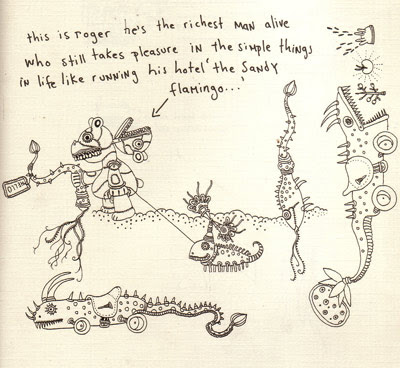
Many of my drawings are unplanned. I pick up a pen, start drawing and get to surprise myself with what appears. Eddie and his family are the result of one of these unplanned wriggles. Eddie is definitely one of my favorite characters - if i were to describe him I would say he is a cross between MacGuyver, Buddha and God. His tail is constantly falling off and then crawls along the ground before burying its tip into soil and growing into a pink flower. Thus wherever Eddie wanders a trail of pink flowers remains. Eddie is the creator of the Household. (see the pic entitled Eddie and Family)

"I was fascinated by the attention and time placed on detail and the blur between fantasy, myth and real life."
Your work has been described as having characteristics of Eastern Art and Art Nouveau as well as being compared to Alphonse Mucha, Arthur Rackham, Adolf Bjorn, and Aubrey Beardsley. How did your style develop and who/what were your influences and why?
Since I was a kid I loved fantasy art. Early influences were African Myths, books like the Tales of Narnia, movies like The Dark Crystal and Willow...my father fueled us with stories of the Spice Island races ...pirates, cowboys, diamond hunters ....
... later I discovered the art of Patrick Woodroffe, Bosch, Medieval art, Russian Folk art, Mayan art, Eastern art, etc... My style really began to develop after my first trip to Indonesia. The temples, puppetry and craft are incredible. I was fascinated by the attention and time placed on detail and the blur between fantasy, myth and real life.

"...I did mostly street art at the time...making little sculptures and paintings that I hid on road sides to surprise people as they walked to work in the mornings."
I understand all of the Blackheart Gang are self-taught; is that right? And would you tell us about the course you took (in regard to learning) to get to where you are today?
Both my grandmother and mother paint so as long as I remember I've entertained myself by creating creatures. After school I studied Fine art for three years...I did mostly street art at the time...making little sculptures and paintings that I hid on road sides to surprise people as they walked to work in the mornings.

After studying I traveled the East and Australia for some time and then found myself in Cape Town. Not long after I arrived I met Markus and we immediately inspired each other. We formed a once off group with some friends calling ourselves the Matchbox Orchestra. Over a period of two weeks we produced a shadow puppet show that we showed at a small theatre called The Armchair Theatre.

Not long afterwards Jannes (Markus's Cousin) moved to town. Markus introduced us to each other and we immediately hit it off and decided to make a music video together for Markus over a weekend . The weekend project ended up stretching into a nine month project as when we began we had very little idea of what we were doing - Jannes and I working obsessively every spare moment. It was really an experiment through which we developed our animation style and The Blackheart gang began.


In regards to your drawing technique, do you begin with outlines of the major objects and then add detail, or do you begin with the details and follow them? And what tools do you use and why?
I begin with the outlines, often drawing straight into pen when possible... I then do the patterning and detail. I generally draw all the elements as separates and then composite them together later. Usually i do all the coloring in Photoshop.

You mention that there were prints, animation, and sculpture on exhibition. How was sculpture used in the project? Or was that something created afterwards? And who created it? (If it was you, would you tell us about the sculptures?)
I got five beautiful sculptures made of different Piranha birds the last time i was in Indonesia. This was the beginning of an idea I've had for some time - to build a museum of the household. Since then i have been collecting and making relics for the museum. - old priest chairs, perfume bottles, Moroccan knifes, magical pieces of jewelery ....... I am currently making the bones of all the piranhas that the pirate piranha kills in the third part of the trilogy. It's going to take me some time but my aim is "find" a relic in every country I go to - eg. designing a carpet of twisted patterns of the household and getting it made in Turkey. Its kinda like a treasure hunt, a story though which to experience the world.
"It will be a heavily illustrated coffee table book that will come with a soundtrack and DVD of animations."
Would you tell us a little more about the exhibition itself and the upcoming book?
The exhibition will be styled like a natural History museum. Let me take a character to explain what i mean.....
The Pirate piranha (you can spot him in the animation, he's the one human legged eye patched guy) will be standing next to a wooden throne holding his Moroccan knife. Hanging around his neck is the pendant of poison which he used to kill the king. Around his feet lie bones of piranha birds he has suspected of plotting against him. Bird heads on stakes surround the throne. The throne is falling apart...we are in a tropical island type environment, the Piranhas are very tribal at this stage. A pirate chest overflows with loot on the side of the throne.

We will have installations like this for all the different main characters - the King, Eddie, the Priest, etc. There will also be maps depicting the route of the Piranha's 100 years of madness, maps of old Otto as well as old drawings of the creatures the piranhas have encountered, writings, sound installations, prints and of course the animations. In short a complete history of Piranhas will be on display.

The book will be like one of those old 'turn the page to sound' Books. It will be a heavily illustrated coffee table book that will come with a soundtrack and DVD of animations.

"I then begin by building up different layers of color with brushes set at very low opacities..."
Would you tell us about the colour palette you use and your technique for colouring? What attracts you to these colours and how has your palette changed over the years?
I draw everything in pen and ink first. I then scan it in and color in Photoshop. I generally use photo textures multiplied over the entire image to begin with. I then begin by building up different layers of color with brushes set at very low opacities....usually about 19%. I color by zooming right into the image at 200% In the case of the Household prints after drawing and coloring the elements for each scene I handed them over to Jannes who then composited the prints. In other cases i lay out the elements myself and usually bind them together but placing a texture or color over the image set at a low opacity.

Me and Markus work together on the concept for the stories...sometimes he writes to my drawings and sometimes I draw to his writing."
Outside your design/drawing, what other work have you done with the Blackheart Gang? How involved are you in developing the story and how did you come to be the “motivator”? Have you had time outside The Household and the Blackheart Gang to work on your own personal projects? And for which pieces that you created outside the Gang do you feel most proud?
I try to tie in all my personnel projects with the Household as its such an extensive project that we need an immortality potion to give us enough time to finish "researching it". Perhaps how i became the "motivator" for the Blackheart Gang is that pretty much every thing i do relates to the household in some way. My favorite piece that I've created yet is a picture i drew of BogWorld. I'm also having a lot of fun building relics in ceramics. I am slowly beginning to transform the inside of my house into a forest/museum scattered with pieces of furniture and relics from the Household. I live in an upstairs wing of an old asylum ....so i have plenty of space inside to gather and grow things in. Me and Markus work together on the concept for the stories...sometimes he writes to my drawings and sometimes I draw to his writing. I also do commercial campaigns and illustrations...clients have included Virgin Atlantic, Levi's, Musica, HP.

PS. Any chance of a cameo by a cat headed peasant?
We don't have a cat headed peasant as yet - we do however have have a floating Cat Brain who belongs to Dr. Benjamin and his better bottom Claude. ...but I wouldn't be surprised if we bumped into a cat headed peasant some where in our wondering the Household.

Thank you, Ree. I'm looking forward to meeting you and the others at Otto's hill.

Read the second installment of the Blackheart Gang interviews with Mr. Jannes HERE.

Links:
BG Interviews Part 2: Mr. Jannes
theblackheartgang.com
The Blackheart Gang Myspace
The Concise Overview of The Household
South African Cartoonists - Ree
Liberated Films - Ree
Motionographer Article
The making of The Tale of How(YouTube)


Return to SiouxWIRE