Showing posts with label video. Show all posts

18 April 2008

Interview: THEO JANSEN

I first discovered Theo Jansen's work just over a year ago and immediately started correspondence with him. Today, we sat down for what is a key interview in the roster bringing together the worlds of science and art in the most natural and unexpected ways.

Theo Jansen studied physics at the University of Delft, Holland before becoming a painter. After his seven year career in painting, he started work on the UFO project which entailed the creation of an actual flying saucer that flew over Delft in 1980 causing pandemonium in the town and attracting considerable attention to his work.


For more than 10 years now, he has been working on the genesis of new nature in his Strandbeest creations which he envisions becoming completely autonomous, intelligent, wind-powered life forms. As an introduction to this work, here is his presentation on this fascinating project for TED:


Theo Jansen: The art of creating creatures


What prompted you to quit your studies of Physics at the University of Delft and becomes a painter?
I was young of course. The hippy period was there. I was distracted from my study by all these new dreams of people and a lot of friends of mine were artists and so I decided to become one as well and started becoming a painter.


And have you continued painting?
No, it stopped as soon as I started the UFO project at the beginning of the eighties and then the UFO project had such a success also media wise and I had been famous for about three months in my country for that and so I chased it more or less on bigger projects. After that, I couldn't paint anymore, sit in my studio and just paint. It wasn't possible anymore.

Following on from your painting, you seem to have had a desire to “work outside the box” and pursue new forms of expression through the painting machine and light sculptures. How did these projects develop?
After the UFO project, I had to do something more technical things and my interest for physics which has never been away during painting, it was really a rebirth in the technical interest after the UFO so I wanted to make something technical.


The painting machine was something interesting because in those days there were no printers yet so it was quite unusual to paint with a painting machine like that especially as the perspective of the images that came out of the painting machine because it made real size photos in front of the wall so the distance didn't matter at all. If a chair was standing a meter or 100 meters it would be the same size. That was the special thing about the painting machine because you could also make the opposite perspective objects with it so I also made photographs of chairs and tables which were in opposite. Things which were closer were smaller and things which were bigger were further away from the wall so it's just the opposite of normal perspective.

What did you learn from them?
My mind was really going on thinking. It made me change my living just for a lot of dreaming about abstract 3D forms in my head and the possibilities of machines. It really did change my thinking and my attitude. I was asked to write a column for a university magazine that really was sort of, this is a Dutch expression, “a stick behind the door”. That means that someone is standing there beating you up when you don't do your homework.


And did this work have any influence on your Strandbeests?
It surely had as this column really forced me to think about anything in the world and because every time I tried to find new, strange perspectives on reality and in effect, the strandbeests they started off as a column in the newspaper and that is about 18 years ago now and in the first period after that nothing happened. I had written the column and then half a year later, I got the idea of going to the shop and buying some of these tubes. I started playing with it and I did that for an afternoon and in the period of the afternoon, I decided to spend one year on these tubes, on these conduits because I saw so many possibilities in there. It turned out to be more than I could ever think of all those years ago.
"...I discovered that I was making new forms of life and by doing that I hoped to get wiser about our existence and our own forms of life."
With the Strandbeests, you have stated that you are making “new nature”; what is your intention in developing “new nature” and what have you learned from your work on the Strandbeests?
The motivation changed. I started off building robots that could gather sands and build up dunes to save us from the raising of the sea level and during working I discovered that I was making new forms of life and by doing that I hoped to get wiser about our existence and our own forms of life.

I have all kinds of theories about symmetry and about multiplying, the sequences in evolution by doing evolution again and new, I think I discovered a lot about the mechanism behind it.

I wrote about this in my book The Great Pretender where I have written many theories about life.


The Animarus Rhinoceros Transport

Are your creations entirely built according to functional parameters or is there some poetry in their design?
Well, the strange thing is that I don't want to make something beautiful. When I work, I always work on function and it turns out when it's finished, it usually doesn't function that well but I surprise myself how beautiful it appears.

Their forms are very beautiful, very poetic.
There's nothing I can do to that. That's sort of this secret artist in me which I'm not aware of secretly making beautiful things.


You have mentioned that the next step in your work is giving your creations brains. Have you made progress in this phase and what does this entail?
Well, the progress is that the nerve cells don't eat that much any more.

Would you briefly explain the nerve cells to put things in context?
Well, the nerve cells are the element, the basic element of the brain. You could also say it's a sort of computer. In a computer, the nerve cell divides where there is an input or output and my nerve cells work in the way that the input is zero and the output is one so it's the opposite from the input and that means if there is air on the input, pressure on the input there is no pressure on the output.

"...the brain will in future contain a time mechanism which runs parallel with the tides of the sea so they will know in advance when the sea is coming..."

With this principle, you can make a network just like in electronics. And so you can make binary counters, time mechanisms. For instance, the brain will in future contain a time mechanism which runs parallel with the tides of the sea so they will know in advance when the sea is coming up so they can go to the dunes before that.


Also, they have sensors which feel the water of the sea. That works quite well these days. They have a sort of tube which is going very close to the ground sucking in air all the time. As soon as it comes into the water, it swallows the water of the sea and then it feels the resistance of it and then it immediately goes the other way out of the sea again because it's longer.

One minute into the rolling surf, they're lost because they're sucked in and cannot come out any more. Future Strandbeests will have step counters which will be reset by feeling the water and they run away from the sea and they count the steps away from the sea so they know where the sea is.


This is what you could call a very primitive imagination. We have our imagination,we have a sort of mirror world in our head which represents the real world around us. It is a copy of the world and our world is very complex but the beach animals world is very simple. On the right hand side is the sea, on the left is the dunes and there's no disposition toward those two elements and so these nerve cells, one nerve cell, works quite well which it does now then the possibilities are endless.

Would you tell us about the animaris speculata that remained attached to its mother acting as a kind of scout? How did this develop and would you tell us a little about how it worked?
Well, it didn't work really well. I've advanced

Is this something you discontinued?
Yes, I stopped the process because I found better ways to feel the soft sand. The animarus speculata worked with a wire in there and there was a lot of friction. It would work a lot better now because the lungs, the wind stomach, plastic bubbles would be a lot better to feed the speculata. It turns out that when the animals run into the soft sand, then the pressure goes up in the animal and you can do this quite easy with a big force that can be pulled out again. These days, they are quite able to walk on soft sand as well, the dry sand.

Theo Jansen's workshop in Ypenburg, Holland

As well as your beasts, there are the programs you’ve developed from the worms simulation to the algorithms you now use for the evolution of the Strandbeests. How have these evolved over time?

I used the computer mainly to develop the lengths of the tubes in the feet. In the middle of each animal there is a sort of backbone which makes a circular movement. The circular movement is transformed into a complex movement down to the toe, the feet. That translation is very much depending on the length of the tubes in between and there are 12 tubes which determines the movement of the toe. The combination of lengths is very important so I wrote a genetic algorithm in an Atari computer to develop the right proportion of the 12 tubes and those were 12 numbers, a sort of genetic code which survived best and these genetic codes are just 12 numbers and I call them also the 12 holy numbers. They determine how the animals walk like they walk.


How important is the environment to you and your work?
Well, I don't think the PVC pipe which I use is very good for the environment. Of course, I never leave them on the beach as part of the environment. The way I work with wind energy is...

Would you consider the environment a partner in creation?
Yes, especially the big dangers on the real beach is the storms. They must always walk with their nose into the wind. When the wind comes sideways they blow over. I work now on programs so they always know where the wind comes from and they put their nose into the wind. Seagulls do the same thing when they are standing on the beach otherwise they would blow away as well.

The place where I work now is quite inland, about 10km inland to have a sort of sandpit, 30m x 50m, here I'm working on them until they're mature enough to go to the real beach because they're not strong enough to survive a very long time in the beaches more than 5 minutes.


So you have a nursery or training area?
Yes. Because the elements on the real beach are a lot worse than they are here. I really must train them a lot better. I think in about 4 years, I'll go to the real beach with the animals and I will have a sort of mobile studio which runs after them and I can do my repairs and hopefully I won't have to do it every third minute like I have to do now.

What was the last thing to surprise you and what did you learn from the experience?
There was an exhibition by a guy called Gerritcan Vakal. He was a Dutch artist and he died in '84 and he made also machines that run on the difference in temperature between day and night. They run very slow. I think they do 3cm a year and he put one of these machines in a desert in Nepal somewhere, he put them in the beginning there and it will be on the other side in 38 million years so that's very funny I think.

Are they still working.
Well, I think the machines never worked but the thought is very good. He is one of the artists that really inspires me. Always when I have an exhibition, I try to include his work.


Generally speaking, art and science tend to make for strange bedfellows with resistence from both sides. Photographer Felice Frankel for example refuses to accept that her work is art and the art world in general is having a difficult time coming to terms to massive influx of new media. Why do you think this is and how do you think the divide between the two can be improved?
Well, I think it is just another matter of what is in people's minds. It's just the institutes that make the people. I mean somewhere where you earn your money, it's what you are. I mean I think engineers are more artists than they want to know and because they work at the university they think well I'm an engineer I'm not an artist. People tend to exaggerate what they think they are. Artists do the same. This world tends to split up just because of psychological reasons.
"If you didn't give anybody money any more, you'll see the real artist and you'll see the real scientist and they'll probably be one person."
And do you think there should be more art in science with more emphasis toward creativity in its tuition?
Well, it's something you cannot force, these boundaries, these institutions give money. You tend to do what gives you the money or recognition. I think if those elements were not there like you have for Eskimos who doesn't have any institution, he doesn't know he's an artist when he makes a little piece of art and he doesn't know he's a scientist when he makes a piece on his canoe to hide him so he can shoot the seals.

If that is the purpose to be blank again and have no prejudice feelings about what you do, I think money would change a lot. If you didn't give anybody money any more, you'll see the real artist and you'll see the real scientist and they'll probably be one person.

Is there any advice you would give parents to nurture children in learning the skills you use?
Yes, well I think when kids go to school they'll usually learn a lot more from each other than they learn from their teachers. So I think putting in a school doesn't matter, if the environment of the kids is okay, they will learn a lot. They might not when they go to economic school or something, they might not become an economist. I don't think the direction or the subject of the school matters so much, I think the mentality is more important than what you study.

And was there anything in your own childhood that led to your current work? (outside playing with pipes)
No, I had a very average family. I don't know how this all came. I think the hippy times did a lot (laughs).


What kind of impact do you hope your work will have both in practical and artistic terms?
What I see now, a lot of people seem to recognize what I do in their own imagination and follow me in my fairytale and become sort of partners or participants. Obviously they don't work with me but stand behind me, support me and really talk with me as if they are part of my project. That of course is something for an artist is very nice when people seem to understand your work.

In the future I hope that these animals will develop in the end that they can live on their own and I don't have to cure them any more and at the end of my life that they will live for a long time after I'm done.

Thank you.
It was a pleasure to do this.

Links:
strandbeest.com
strandbeestmovie.com
Theo Jansen Wiki
Theo Jansen (Art Futura)
Wild Things Are on the Beach (Wired)
Theo Jansen (TED Profile)
Interview (artificial.dk)
Theo Jansen (Galerie Akinci)


12 April 2008

Interview: RICEBOY SLEEPS

Riceboy Sleeps is an art collaboration between Jónsi Birgisson and Alex Somers comprised of still images, music, video, and storytelling. Releasing a picture book in Iceland in 2006(1000 hand numbered editions), they held their first exhibition at Gallery Turpentine in Reykjavik.

In 2007, a second unnumbered edition of the book was released as well as two singles, All the big trees and Daniel in the Sea. Further exhibitions outside Iceland followed in the US and Australia. They currently have an exhibition at the Agency Gallery in London(10 April-17 May, 2008).

Jónsi Birgisson is also a member and lead singer for Sigur Rós and Alex Somers who has worked on artwork for Sigur Rós is a member of the band Parachutes. As Jónsi and Alex were setting up their exhibition in London as the interview was conducted, each was interviewed separately though the answers are presented here in a compiled format.


Sioux:
How did the Moss Stories and Riceboy Sleeps project develop and what were your motivations?
Alex: The project began four years ago and there was never any motivation, we didn't realise that we were starting a real project. It was just the two of us making music and making artwork for fun really.
Jonsi: It just started with me and Alex and we wanted to do something together. Alex is just in the same headspace.

Sioux: Did that start from the videos you've done?
Alex: Actually, we started making music a long time ago and we made lots of songs and we were recording and stuff and then at some point since we both did videos on our own, we decided it would be fun to make videos for some of our songs and that's how it began and then Jonsi and I moved in together so we began drawing and painting a lot together.


Sioux: What would you say are the key differences in your musical work with Riceboy Sleeps as opposed to your creations with Sigur Ros and Parachutes?
Alex: It's quite similar. We use the same instruments, same microphones. I think the process is quite similar except Parachutes is Scott and I, and Riceboy is Jonsi and I. I think working with Jonsi, everything is much more brave and spontaneous and I think with Parachutes we're not as brave as Jonsi, he's so brave in trying and going for things. And sometimes I forget that if I'm not working with him . They're quite similar.
Jonsi: Yeah, just different. Me and Alex work differently. Riceboy is more like playing with sounds.


Sigur Rós - Glósóli


Sioux: And would you say the Riceboy Sleeps project will have an impact on your future work in Sigur Ros and Parachutes? If so why and in what way?
Alex: I don't know. We have plenty of time to do both and we've had offers to do Riceboy and Parachutes projects together. I don't know if that will happen or not. And I don't think either will effect the other in a negative way, only a positive way, more creation and more making and having fun.
Jonsi: I don't know. It could do.


Sioux: Does the aged and worn aesthetic signify anything in particular to you and your work? And what was the motivation in using old, rustic frames in your gallery work?
Alex: It's more of a feeling and atmosphere we're trying to create than a specific message. We're never really aware of trying to tell people something, we're more interested in having people feel something so it's just a really good feeling and something we've both been really attracted to before we even met eachother. It's comfortable, it feels like things have soul. Before we met, we were both collecting old photographs and old books and didn't really know why, we just both really like them. Then when we started making artwork, it just got incorporated into our work.
Jonsi: We do the pictures first and we found these frames just lying and it would kind of suit so well with the other stuff we were doing.

"...when I met Jonsi, I was really, really poor and I was just living off of rice mostly..."
Sioux: Who is Rice Boy?
Alex: When it started out, it was the name of one of our songs called Riceboy Sleeps. It was just because when I met Jonsi, I was really, really poor and I was just living off of rice mostly and I was sleeping too much so Jonsi was writing a song while I was asleep one day and he named it Riceboy Sleeps. For some reason ever since then we just called whatever we were working on at the time, Riceboy Sleeps. We never decided for that to be officially be our name, it just happened.


Riceboy Sleeps - Daniel in the sea

Sioux: And Daníell(in the sea)?
Alex: Oh, he is just a fictitious character based like, we make stories also. He's just a character. He's just a really beautiful character and sometimes he's blind in our stories and sometimes he's not blind. Maybe because all the stories haven't quite finished so we're not really sure what is happening.

Sioux: Would you tell us about the creation of the accompanying videos and how they relate to the book itself?
Alex: Actually, they don't really relate to the book though everything shares a similar aesthetic. The do go with the book. It's a similar texture and feeling though conceptually they're not matched.


Riceboy Sleeps - All the big trees

Sioux: All the big trees is an unusual title considering Iceland is without trees. What do trees mean to you?
Alex: We both love trees. They're so beautiful. The title was actually made in the States, on the east coast in Maryland. Jonsi made a present for my mother and on the back he wrote 'thank you for all the big trees' and I think somehow stuck with us and we just used it for a song. Forests, I find them beautiful and full of life, amazing sounds, wind blowing through the trees, good smell...
Jonsi: I just like them when I went to visit Alex's mother who lives in Maryland, there were so many trees in their backyard, so big, so nice and cosy, comfortable.

Sioux: Is there a particular significance in the boy and girl that feature in the Riceboy Sleeps book? (Jonsi) Is that you and your sister, Sigurrós?
Jonsi: Me and my sister? (laughs) No, definitely not. Just fictional characters.

Sioux: Would you characterise your work as Icelandic? And what influence would you say Iceland, Reykjavik and its artists have had on your work?
Alex: I don't know. Probably not. Just the support and encouragement that I've known in Iceland. People don't judge you when you're making artwork and music and people support you and it's a small community. In other cities, I found it's maybe more judgemental instead of just supporting you and I find that a very encouraging environment to live and work in.
Jonsi: No, I think, yeah maybe, but you do whatever you are, your characteristics.


Sioux: What are your thoughts on the categorization of arts between “high brow”, “low brow”, “fine art”, and “outsider art”? Do you feel these labels serve any purpose?
Alex: No, not really. I don't even know where we would fit in. I've never really thought about it. It's like people need to box things up, but no, I don't think it's important.
Jonsi: They probably serve a purpose for those in the artworld, but of course it doesn't matter.


Sioux: What is your favourite technology and why?
Alex: Favourite technology? That's tricky. When we make our stuff we really like to make it as organic as possible though we use computers for layering and scanning things like that. And for scanning in our drawings and reshaping them and playing with the format. We like to use the computer and scanner. I don't know. Favourite technology? It sounds so bad if I say a computer. We don't really like graphic design so we don't want our stuff to look graphic design-y or anything like that.
Jonsi: Maybe the, I don't know. Maybe computers. Maybe the most important one. There's so much freedom, you can use it whatever way you want.

Sioux: Would you choose a colour (it doesn’t have to be a favourite) and explain the ideas and feelings it generates for you?
Alex: The only thing I can think of is that in the last year, I've got really into the colour light blue. I don't really know why. I just like it when I see it, something like a light blue boat that's washed out faded. It's just really beautiful, like a worn or washed out feeling. I see it on boats a lot in the harbour.
Jonsi: Light blue. Did Alex say light blue?
Sioux: Yes, he did.
Jonsi: (laughs) Yeah, we both really like light blue. It has to be perfect light blue, worn out light blue, old chipping paint... It's so soft or something. I think we actually like all colours if they're desaturated or worn out.


Sioux: Also, would you select an image that you feel is powerful (it can be a painting, a photograph—and does not need to be art, it could be a package design or an object) and explain why it has an impact on you?
Alex: Hmm. The last couple of years it would be anything in nature. I'm just super into nature; trees, plants, fruits.vegetables. I just like to be as close to that as possible.
Jonsi: Indirectly, there's a lot of people, my friends, my family, my sister is doing a lot of cool stuff with the full moon and meteors.

Sioux: And if we end with a political message, a piece of advice to artists, and a recommendation?
Alex: Be honest. Just make what you want to make. I don't feel I'm in a position to make any recommendations. That's the only thing that's important is to be true to yourself.
Jonsi: Just to be as honest in what you do and to create as much as you can, it gives you so much purpose if you create a lot of stuff and you're honest in that creation. It gives you so much and makes life worth living.

Sioux: Thank you.


Links:
Riceboy Sleeps
Riceboy Sleeps MySpace
Riceboy Sleeps Wiki
Moss Stories
Gallery 801
The Agency Gallery
Gallery Turpentine
Sigur Ros
Parachutes
Book Gallery

22 May 2007

Interview: The Blackheart Gang - MR. JANNES


In the second of the Blackheart Gang interviews, we have Jannes Hendrikz whose responsibility is in essence to make Ree Treweek's drawings dance to Markus Wormstorm's music. He is the compositor, 2d-animator, cinematographer, and creative director of the team. Jannes recently left Blackginger (who created the 3d elements and provided the hardware required for The Tale of How) to freelance.

As well as providing generous answers to my queries, he has also kindly provided some exclusive stills and moving images from early in the production of The Tale of How.

The Tale of How is free to download HERE and more information is available in previous posts HERE, HERE and HERE. See the first installment of the Blackheart Gang interviews with Ree Treweek HERE.

From the perspective of artistic direction, is the look from the Tale of How something you want preserved or do you see the project evolving over time?
I am very much into spontaneous, interactive expression of our art forms. I see The Household project as a growing interactive medium. It goes wherever it needs to go and I follow. It’s about being attentive to its needs and letting it grow.

How important was Ringo as a foundation for the work you did in The Tale of How? What did you learn while working on it? And is Ringo set in The Household?
Yes, Ringo also forms part of The Household. Before we started Ringo none of us knew eachother that well; most of us had just met at the time. We wanted to do something, make something. I don't know. A type of creative chemistry just developed among us. At the time, none of us had any real experience; we just threw ourselves into it. Ringo started as a weekend project but we ended up working on it for another nine months. We didn't plan. Things just developed. I think that this is the basis of our working dynamic--the magic. We learned as we went along with it.
"We did have a few creative hiccups and we had to move on--we had to compromise, we had to collaborate."
Being a labour of love, you kind of need to offer everyone working on the project the freedom to express themselves so it gets really difficult to do what you want without overlapping with someone else's ideas. We did have a few creative hiccups and we had to move on--we had to compromise, we had to collaborate. This was the biggest lesson Ringo taught us and this secret lies at the base of our collective. Learning to collaborate opens up creative doors and solutions, and helps you to develop into a more mature artist. It helps you define yourself and your role. And this was the next lesson.


Ringo(2004)

We knew that if we were to work on the next project we would have to define our roles. So before working on Tale of How we had loads of discussions about who wants to do what and what we'd like to achieve and how we can support each other in doing so. I had to be very sensitive to the needs of the people I asked to join. I really wanted to create an environment for everyone to grow. Ringo was an essential part of my growth.


You said you nearly had a nervous breakdown at the end of the nine month development of the Tale of How; what happened? Was it that bad?
Hmm...well...yes, it was bad. I wasn't exaggerating. It really took me months to recover. I had a full time job at the time at a visual-effects company that always had work for me. The day work was demanding. So I worked from 9 - 6. popped out for an hour dinner break where I would meet up with Ree. This was our time to see friends and loved ones before we return to Blackginger to work till 1 - 3 in the morning. This was the ritual for every other day, except weekends where we would work from 10 in the morning to late at night.

During this time me and my girlfriend bought a flat that we moved into. By the end of it...the last 2 months, my morale was at an all time low. I was tired and worn out. I had to focus myself to finish this thing that took over my life. My boss was complaining that my private life is interfering with my ability at work. My girlfriend at this point completely frustrated with the fact that I'm never at home and emotionally unavailable. The last weeks I kept on falling asleep watching renders, stared into space and when we finally finished both me and Ree didnt know what to think. We didn't know what to feel and then slowly, over the next few months, readjusted to normal life again.

The whole experience was very surreal. I suppose I just have a very intense way of experiencing life around me, I am very passionate. It's the only way I can explain why I push so hard.


Would you give us an idea of your workflow in particular, how you bridge the 2D and 3D in your work? And which software/hardware is/was involved and why? How closely did you work with Justin Baker in the development of the 3D elements and how difficult was it to preserve the look of Ree’s drawings?
I always composite in 3d space; it gives me freedom to play with depth and perspective but then again, I really didn't want it to look like a 3d movie, or like a 2d movie in 3d space. I wanted something authentic so when it came to using actual 3d renders, I decided that they had to look exactly like Ree's linework. Justin modeled and rigged the birds and then started playing around with different shaders. We went backwards and forwards till we found a treatment that worked.

Justin then started animating all the elements on a background plate (2k resolution) I supplied as a placing reference. The 3d renders would then be layered into my comp and the camera moves added. Justin had full freedom to animate the birds using his own interpretation of the story. The only limitations were technicalities or keeping within the story. Me and Justin used to work together at Blackginger, so we were already familiar with our own type of workflow.

We worked on duel 3 gigahertz Dell machines with 3 gigs memory. Justin worked with XSI and I worked with After Effects 6.5. XSI has amazing 2d shader capabilities and rendering in passes also helps. After effects is definitely the only package to use for a project like this. Other compositing packages will not be able to perform in the same way or offer me the same amount of freedom.


Time Lapse Composition

You’ve mentioned that each scene was made up of around 300 layers; what challenges did this present and what did you learn working with such a rich tapestry of elements?
One half of all the elements was Ree's drawings and the other half consisted of atmospherics (mostly video footage) and textures. The first challenge was getting my computer to process all of this. I basically broke each shot into 3 main layers: fore, middle and background. Whenever possible, I rendered out the frames of finished sets, and used them as proxies to be able to render a full shot. I also had to set my views to as low as quarter resolution to be able to preview the shots over the timeline.
"Having so many elements certainly slowed me down, but being able to chop and change and play at any point during the process definitely added to the look of the film."
Most of the time, I just had to render the shots at the end of the night before we left, to be able to check the animation I did during that night. Having so many elements certainly slowed me down, but being able to chop and change and play at any point during the process definitely added to the look of the film. You just need the time to be able to do that. Every shot was crafted and cared for till it felt right, and having all the layers available helped me work like that. In the end, we ran out of time, and some things just had to be left the way they were knowing that we did the best we can.


In creating what we now see as The Tale of How, were there any other versions of the composite before the final? If so, can you describe these?
Well, before we started on the prints, Ree gave me her drawings for page 1 (shot 1). I played around and tested a few ideas. when I finally felt I had something, I really wanted to test it out animated, so I downresed the psd, collected some video elements I had, and put everything together. this was a starting point that I felt happy with and got Ree and Markus to have a look at it. They loved it and thats where it went. In the following days I basically tested cameras and their movement, a few animation teqniques and thought about the workflow and basically made 5 variations of the first test render, and that was that. I knew that I had loads of time to think about the animation while composing the prints and things developed from there.


The first composite test for Tale of How

Are storyboards used at all? Why or why not?
No, we didnt use storyboards for Tale of How. We had 13 verses in Markus's poem and one print for each. The prints took us about 3 months then Ree had to start drawing on all the extra elements we would need for the animation and I started putting things together. We wanted to have more shots and angles but we simply did not have the manpower and time to do so, so we made each shot as beautifull as we could hoping that visually one would have enough to look at and that we could get away with the shots we had.
"I used this part of the animation to add drama and break the pace by using quicker cuts and camera moves unlike anywhere else in the piece."
We just knew that the first part of the story needed to be dark and eerie, and the second half, light and hopeful. We also didn't use the print for shot 8 (the part where the bird gets broken in half) because we needed to build a more dynamic and visually interesting picture than we had. I used this part of the animation to add drama and break the pace by using quicker cuts and camera moves unlike anywhere else in the piece. Our workflow was very much based on the prints. It will be very different for our next projects. We believe in the power of using storyboards.


How far off is The Tale of Then from completion? And what work has been done thus far? Likewise for The Tale of When?
We are planning to start by the end of the year. Now we are just getting our resources together, getting the story fine tuned, then do storyboards, animatics etc etc.--Lots of pre-preparation. We are giving ourselves a year of production time on the next one...all depending on resources. We might even work on the Tale of When at the same time, we don't know, we'll have to see how things develop over time.

What arts do you practice personally outside the Blackheart Gang? And which artists inspire you personally?
Well, the Blackheart Gang's been taking up all my time. If there were a few things I could wish for, it would be for extra arms, the ability to not having to sleep, and longer nights. ah...what I can tell you are my wants. I want to shoot documentries, I want to make puppets, I want to start a theatre production, make music.... sigh!
"Cooking is great because it involves so many of the senses."
As a video & film artist, I am quite removed from the final product. There's a long process to this medium. it rarely ever gives you immediate interaction like playing a musical instrument. Processing just takes too long. The other frustration is that it is a virtual medium. There is no real tangibility so I do long for a more hands-on form of expression. There is something I do regularly, and that is cook. Cooking is great because it involves so many of the senses. It offers so much variety to experiment with, and you can eat what you've made!

I am a lover of listening to sound and music. I can honestly say that I spend 70% of my time on listening. Sound is my deepest source of inspiration. I suppose it’s because it gives me full freedom to interpret it visually. I initially got into video because I visually wanted to create what I saw when listening to music. I like moody, emotional music. Some favourites at the moment include: Svarte Greiner, Dictaphone, Rafael Anton Irisarri, Apparat, Loscil, and the Shins.


I also draw a lot of inspiration from short films at the moment. Its such an amazing medium, such a huge variety of style, technique and experimentation. I am in love with moving picture, it’s enchanting, especially sincere storytelling, mostly without dialogue. Slow visual storytelling oh! I am very much into Russian animation from the 60's and 70's. The beauty, sensitivity and wonder of Miyazaki's films damn! His films always revitalizes me, reminds me of what's really important. Also, my brother gave me a collection of stop-motion by the Quay Brothers and I recently discovered the surreal and bizarre etchings by Max Ernst. Difficult to name specifics... cause I pick up little bits here and there, tiptoeing over what keeps me going.


What have been some of the most important things both personally and professionally that you’ve learned while working on the Blackheart Gang projects?
As an artist, I’ve never learned so much, so fast. Working on these projects and being an artist, I suppose that my personal and professional life goes hand in hand so I've learnt that work is not about the end product; it is about the time you spend around that and how you deal with yourself and others in that time. Enjoying your work and staying true to it is essential. I know now that my self expression is an in-the-moment thing, and it’s at those times when I can truly experience myself and get to know myself and my abilities better... pulling your hair out in despondency, the height of accomplishment, the stress of a deadline or those flowing moments of spontaneity.

Thank you, Jannes. I can't wait to see more of The Household. See you on Otto's hill.

Links:
Ree Treweek Interview
theblackheartgang.com
The Blackheart Gang Myspace
The Concise Overview of The Household
Motionographer Article
The making of The Tale of How(YouTube)
Blackginger


Return to SiouxWIRE

12 May 2007

Interview: SIL VAN DER WOERD


Sil van der Woerd is an independent filmmaker and graduate of the Academy of Arts and Design in Arnhem, Netherlands and attended the Gnomon School of Visual Effects. In 2004, he created Duet and recently released his follow-up Swim. Both works combine live action, effects, and music to carry their narratives and create unique environments.


Swim


Duet


Do you see yourself as an artist, craftsman, or combination of the two? And why?
As an artist. I make films because I want to share a story with an audience, to show them worlds that are inside my head. I don't make films to show that I am able to make them. The precise work of reaching a certain level of detail in the images (to make the imaginative worlds appear convincing) could be called craftsmanship though.

Soundtracks are a dominant feature of your work. Would you explain your choices of music for both Duet and Swim, and how they relate tothe shorts as a whole?
I pick the soundtracks to underline the films atmosphere. For Duet, I wanted a combination of classical and modern music, since that was the theme of the film. I chose heavy beats because I wanted every contradictory and energetic element opposite the sweet girl and dragonfly.

For Swim, I wanted a pulsing soundtrack, subtle in it's changes. Cold, almost like the sound of the ramming of piles underwater.

"Swim was born out of a collection of sketches and a desire to somehow show how insanely magic the power of life really is."
How did the concept for Duet and Swim come about?
The concept for Duet was born while exploring the borders of live action and animation. I was thinking about what animation would need to stand up against live action and visa versa. I started playing with the idea of melted contradictions. Modern and classical dance and music, digital and real images, etc. In Duet, my goal was to bring these elements together and make 1 convincing performance out of it. Swim was born out of a collection of sketches and a desire to somehow show how insanely magic the power of life really is. I wanted to create an almost dead, high tech, by humans controlled space, that would shrink to no importance at the moment new life is born and the forces of nature take over.

When creating your works, what is the most important element and why?
Music is the starting point and biggest inspiration. When I listen to music, visuals automatically start pouring into my head. Music is a great inspiration because music is so widely interpretable.


While working in CG, it's all too easy to fixate on the craft of building as opposed to the overall design; a bit like an architect focusing too much on the building methods as opposed to the end product. Do you recognise this problem and if so, how do you avoid it?
I am familiar with the state of being lost in modeling and aiming for a photo realistic look. CG eats up a lot of time because you yourself decide when your work is finished, and if you're a bit self critic like me, it never really is. So to avoid that, I usually work heavily on a model for a short amount of time. Then I step away from it, and finish it once I am fresh again, or have the courage to throw it away. Deadlines also greatly help to effectively make creative decisions in reasonable amounts of time.
"I learned a lot to literally do every facet of the productions myself."
What would you say are the positives and negatives of CG work?
Positive: no boundaries; all you can imagine is make-able and can appear convincingly real. Negative: no boundaries; because everything is possible, one can easily get lost in the techniques and spend months and months while not being very creative. I feel that certain restrictions are helpful to fully use up the restricted space and find it's boundaries.

Would you tell us about the work flow you employed in your shortsand the software/hardware used? And what were the most importantthings you learned while creating Duet and Swim?
I make the films by myself. This means I am responsible for concept, camera handling, light, producing, editing, animation and visual effects. It may not be the most effective way, but I learned a lot to literally do every facet of the productions myself. The only thing I don't have credit for is the music. I learned the software (Maya, ZBrush, After Effects, Boujou) myself while studying at the Academy in Arnhem and during courses at Gnomon School of Visual Effects in Hollywood. The most important thing I've learned is to make sure that every single function in the pipeline of making a film is of great importance and needs an equal attention. I also learned, that if I want to keep on working on bigger projects without losing my creativity, I need to give certain functions of the process to specialized people, which is what I am doing in my current projects.


How was your time at the Gnomon School? And how does your experiencecompare to your time at the Academy of Arts and Design in Arnhem?
Gnomon was great, I had a wonder full time. Gnomon is all about the technique. They have very experienced teachers. It was the opposite of the Academy in Arnhem where there were no professionals in animation and where it was about the concept mainly. I think these studies were a good combination; at the Academy I discovered my own style and it's importance while at Gnomon I learned to raise the technical side of my work to a more professional level. At Gnomon I also had a great chance to experience some of the film-industry from backstage.

Who are the artists that inspire you and why?
I find inspiration in old Disney movies, Bjork, Chris Cunningham, Arvo Part, Speedy J. To me, these are artists whose work is close to nature or is the exact opposite of it.

What aspirations do you have for the future? And what are youworking on at the moment and when will we see new work from you?
Right now, I am focusing on being a director of music videos. In the future I hope to direct a feature film. At the moment, I am finishing a music video for singer Lolly Jane Blue. The video, called 'Worms' is almost 6 months in production and will be released on Thursday October 4th 2007. Worms will be available on my own website www.microbia.nl and on the singer's website: www.lollyjaneblue.com

Links:
Microbia
Revver

17 April 2007

Interview: KATE O'BRIEN


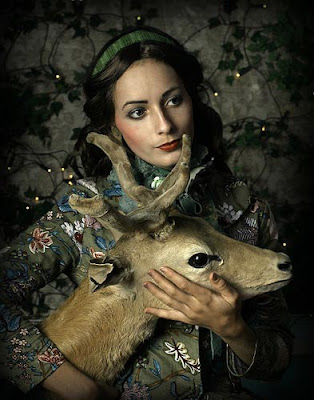
Kate O'Brien creates wonderfully textured images with some of the best understanding of colour that I've seen in a long time. To me, her work is split into two sides, each with their own colour palette. I'm tempted to say good and evil, but the good is often tempered with a touch of evil and the bad is tempered with a touch of good.

On her site bio, it states "Projects are sometimes years in the making while Kate scours online auctions, op-shops, thrift stores and liquidators looking for just the right piece to complete the vision."

It feels as if her work is moving into a new phase and it was a great privilege to have been able to put my questions to her at this time.


To begin, I'm noticing that your work seems to be branching out in two directions. On one hand, there is a hemisphere of more muted, earthy colours with a more painterly style and earnest tone. On the flip side there's a bright, candy-coloured playground of mischief. Are you aware of this? If so, is there a definite reasoning behind it or it a kind of counterbalance to your moods? Or is it simply a new direction in which you are going?
I’m completely aware of it. I feel like over the past couple of months I am finally finding my feet. Prior to my recent work I felt a little bit directionless…sure, I had lots of ideas, in fact that’s one thing I think I’ll always have plenty of, but there didn’t seem to be any continuity to the work. It could be described as show-ponying. Just showing off what I could do, rather than having a distinct vision to what I was doing.

I have said before that I wanted my work to show the highs and lows of the human existence, but in some ways I feel that I didn’t achieve that at all. So, I guess now I’m just sticking to the lows for a bit. That’s the life I know best.

"...I get a lot of satisfaction out of exposing a little world my viewers can peek into..."

You’ve mentioned the importance of childhood memories on your work in your site bio. Which memories are feeding your most recent work?
I guess it’s not really about distinct memories. It’s about the innocence we lose as we grow up and become adults. Some of my work, particularly the vintage styled work is about memories that I create. It’s difficult to explain, but they aren’t my memories. I create memories for unknown people; - the characters I create in my photographs.

I guess I get a lot of satisfaction out of exposing a little world my viewers can peek into for a person that never really was.


You were studying intermedia and sculpture until your final year at the Queensland College of Art; what finally convinced you that photography was the calling you wanted to follow and why?
I’ve never been very good at sticking to anything I wasn’t skilled at. My sculptural work is some of the worst art I’ve ever made. I went through primary (elementary) school, high school and university knowing I had “something”, but I didn’t know how to channel it. I tried painting, drawing etc etc but have always been frustrated with the limitations of the medium or with my own ability to use it.

There are so many reasons why photography has been a natural progression for me. Mostly I suppose it allows me to indulge my passions. Obviously, I like making things, costumes, sets etc etc. I love ancient and modern history, so being able to justify collecting antiques and junk to use as props is pretty cool. I guess I also enjoy the satisfaction I get from producing a really good piece of work and knowing I was able to do it on an extremely tight budget.

In reality, I learned to use the camera to document what I was doing with models and props rather than the other way around. I never fancied myself as a photographer until early 2005 when I started playing around with a rather old 2.2MP digital camera my brother had somehow gained through questionable means. I didn’t get my first digital SLR until November 2006.

Although I’m yet to land a regular photography gig, I do sense a degree of jealously from colleagues who studied photography for 4 years at art school and haven’t had as much success or attention and when I’m asked by younger photographers starting out for advice, I always tell them that you can learn technique later, but if you don’t have ideas or you can’t realize them then you may end up shooting weddings your entire life!

"I kind of turned my back on the art world and traditional pathways..."

What do you think about the division of art into “fine art”, “pop art”, “street art”, etc.? And have you found it difficult not subscribing to the ideal of the “artist in the ivory tower”?
I guess I don’t really agree with those divisions. I’m sure I sound kind of ignorant saying this, but when it boils down to it, there is good art and bad art, there probably isn’t even that because it’s such a subjective issue. But you know what I mean? Good art for me is when all the elements of design are married together in the one image in a really harmonious way. So whether it is street art or fine art is irrelevant to me, if it has all the right elements, I’ll probably like it.

As for the artist in the ivory tower thing, I guess I like to see myself as a down-to-earth kind of person. Sure, I like the attention I get via my work, but I don’t want to be adored…respected is good enough for me.
I kind of turned my back on the art world and traditional pathways for that exact reason, and I probably shot myself in the foot because of it, but I can’t stand the bitchiness and the posturing that has to be done. If the work is good, good and if it sucks, fair enough but don’t ask me to brown-nose my way to the top. I just don’t have it in me.


Do you view digital and analogue photographic techniques (and their results) differently?
Oh yeah, for sure! I haven’t shot with film for years now. I’m no purist.

I’d love to have my own darkroom and lovely Rolleiflex camera, but I have fun with my little DSLR and I love the results I get out of it. Sometimes I wonder how I’d go shooting film again. I guess you learn to trust your ability more with film. Working digitally is like having a little safety net to tell you if you’re on track or not.


The 'Black Forest' Photoshoot

What’s that enchanting melody?
I’m a big fan of Jewish culture and I love Klezmer music (possibly a by-product of 7 years of clarinet lessons while I was growing up). The song is called ‘Nigun’ and it is by The Brandeis-Bardin Klezmer Ensemble. I chose it because it is very sad and dark which I felt suited the mood of that set of images. Music has become an important part of my work lately. It is inspiring me to perhaps attempt a music video at some point in the future.

What other arts do you practice or interest you outside photography? (And what impact have they had on your photographic work)?
There is so much work involved in my photos, ranging from makeup to sourcing the props for the photos that I don’t find a lot of time for anything else. Of course I am still working through my education degree as well, so my plate is pretty full already right now, although I always find time for my three ducks and two cats!

What advice would you give to up-and-coming artists aiming to make a career from photography (or art in general)?
Don’t ever accept less than you’re worth. You’ll both regret and resent it later…and it’ll make you a bitter old crow….like me

And any advice for the photographer on a budget?
Live and breathe your work and you will see opportunities everywhere you look. Beg, borrow and steal to get what you want.

Oh yes, and what did you do with the $32 deer’s head?
It’s hanging on my studio wall of course!

Thank you, Kate. I'm always looking forward to seeing new work from you. You're a star.


Links:
eyecandyforthebrokenhearted.com
Kate O'Brien/EyeCandy... Flickr
Kate O'Brien/EyeCandy... MySpace


Return to SiouxWIRE